


Oak Woodlands
In the foothills and coastal plains of Orange County, large gnarled trees with wide, sweeping canopies are scattered throughout fields of shrubs and grasses. The magnificent Oak Woodlands are often interwoven between chaparral and riparian biomes across the state of California. This biome can be found in coastal plains, intermountain valleys, and low mountains, at elevation ranging from sea level to 5000 feet. The Oak Woodlands are found in California’s Mediterranean-type climate, characterized by wet winters and dry, hot summers, with some variation in weather patterns from proximity to the coast and latitude.
The Oak woodlands are a unique biome, although the canopy cover and the understory composition varies from place to place. Oak woodlands are distinguished by a canopy cover of 10% or more, meaning that at least 10% of the sky overhead is shaded by oak branches. This distinguishes the Oak Woodlands from Oak Savannah, where trees are too widely spaced out to form a connected layer overhead, vastly changing the plants that live below the oak trees (NatureServe Explorer 2.0, 2025). Annual grasses form most of the understory in open Oak Woodlands, though shrubs that are shade-tolerant dominate dense woodlands. This is because the canopy cover creates a microclimate that is significantly cooler than the surrounding air. Some examples of shade-tolerant shrubs that thrive in this environment include poison oak (Toxicodendron diversilobum), California coffeeberry (Rhamnus californica), and species of California Lilac (Ceanothus). The specific species of shrubs in a given understory is often dependent on local rainfall rates (Holland, n.d.).
Varying oak woodland types dominate across the landscapes of California. Blue oak woodlands are commonly found in the Central Valley and the foothills of the Sierra Nevada Mountains. The primary oak species in these woodlands is the Blue oaks (Quercus douglasii). Coastal Oakwood lands can be found throughout the coastal regions of California. The composition of Coastal Oak woodlands are more variable, and different oak species dominate across the state. Coast live oak (Quercus agrifolia) is commonly found throughout central and southern California
Blue Oak Woodlands consist of 85-100% Blue Oak, with other oak species scattered throughout the canopy (Ritter, n.d). Blue oaks are broadleaf deciduous trees, meaning they shed their leaves in the fall. Blue oaks are easily recognized by their pale grey, textured bark and blue-green leaves that are dull and papery, with a leathery sheen that protects them from water loss and California’s intense summer heat (Blue Oak, n.d.). These leaves are often irregularly shaped, with a wavy pattern, and they are known to break when they are folded. Blue oaks are endemic to California, meaning they are found nowhere else in the world, and they thrive on the hot, dry foothills and slopes of the Central Valley (Blue Oak, n.d.). These trees have been recorded to live over 500 years, making them some of the longest-lived oaks in the region. Blue oaks reach heights of 80 feet, and their canopy can spread over 30 feet wide, providing generous shade and shelter for the organisms living beneath them (Blue Oak, n.d.). Blue oaks also have thinner bark than Coast Live Oaks, which allows them to survive low-intensity fires, but high-intensity fires can be deadly to these trees, making the increasing severity of California wildfires a growing concern for their survival.

Photo Credits: https://calscape.org/Quercus-douglasii-(Blue-Oak)
One of the most fascinating things about Blue Oaks is how they reproduce. Entire Blue Oak populations synchronize their acorn production, yielding an abundance of acorns one year, then very little the next. This pattern, known as mast seeding, is a clever survival strategy. By making the food supply unpredictable, Blue Oaks discourage seed predators from permanently settling in the woodland, since no animal can reliably count on a steady food source year after year (Blue Oak, n.d.).
Coastal Oak Woodlands are more variable in composition and are dominated by Coast Live Oak south of Sonoma County. Coast Live Oak is the only native California oak species that thrives in the Coastal environment. It is tolerant of the salty air and prefers the milder climate the ocean creates (Coast Live Oak, 2018). This tree is resistant to most high intensity fires due to its very thick bark (California Oak Tree Species ID and Ecology | UC Oaks, 2026). Coast live oak often grows in drier areas with a deep, well-draining soil (NatureServe Explorer 2.0, 2025).
Coast Life Oak reaches heights of 30-80 feet and can live for over 250 years. Its canopy is very wide, reaching over 130 feet across. This tree is a broadleaf evergreen, meaning it keeps its leaves year-round. Its oval-shaped leaves are thick and leathery, with edges that curl downward and are lined with sharp points (Coast Live Oak, 2018). The top of the leaf is a shiny green color, while the underside is much duller and slightly fuzzy where the veins branch out (Coast Live Oak, 2018). This tree produces slim, cone-shaped acorns that are light brown with a grey-brown cap. (Coast Live Oak, 2018). These acorns take one year to mature and drop in early fall. As with all oaks, the Coast Live Oak acorn is a prominent food source for around 270 native species in this habitat. In the late winter months, the gathered acorns that are left behind or buried and forgotten by these animals become the seedlings that grow to be the next generation of Coast Live Oak trees.
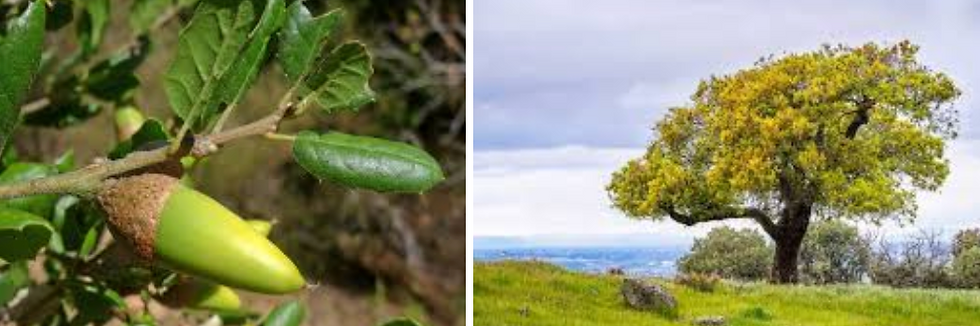
Photo Credits: https://calscape.org/Quercus-agrifolia-(Coast-Live-Oak)
Engelmann oaks are native to southern California; they can be found in California’s floristic provinces, such as the San Gabriel and San Jacinto mountain ranges, Peninsular ranges, and the South Coast, though the majority of their remaining population can be found in San Diego County (Oaks et al., n.d.). They occasionally grow in their own stands, but are often found interspersed with Coast Live Oak throughout Coastal Oak Woodlands. They are easy to spot amongst stands of Coast Live Oak because the Engelmann oak has an untamed character compared to the orderly Coast Live Oak. This oak sprawls with twisted branches and an open, airy canopy (How to Identify An Engelmann Oak, 2026). The Engelmann Oak has long, elliptical green to grey leaves that are occasionally tinged blue and fiddle-shaped (How to Identify An Engelmann Oak, 2026). They produce stubby brown acorns that are much shorter than the Coast Live Oak, though both species drop thousands of acorns annually.
The Engelmann oak once covered a far larger range across Southern California, but climatic drying during the formation of the Sonoran and Mojave Deserts gradually shrank its population. Today, an astonishing 93% of the remaining Engelmann oak population is concentrated in the Black Mountains of central San Diego County, with less than 0.5% found right here in Orange County (Pacific Horticulture | The Most Majestic Southern California Oak, 2024). Historically, Native Americans relied heavily on Engelmann oak acorns as a food source, often grinding them into porridges. The Diegueno tribe near San Diego even made a candy from the pounded bark of the tree that resembled chewing gum. Because so few Engelmann oaks remain, natural regeneration through acorn dispersal is very limited.

The Oak Woodlands are home to many interesting species, such as the Acorn Woodpecker (Melanerpes formicivorus)and the California Ground Squirrel (Otospermophilus beecheyi). The Acorn Woodpecker is most often found in Oak Woodlands, but can also be found in pine woodlands. These woodpeckers are mostly black, with a creamy white face and a red crown, though this crown is much shorter on the females. Their tongue is narrow with a spiny texture that helps them catch insects. Their tongue wraps around their brain to protect it from the impact of repeated wood strikes. The Acorn Woodpecker is known to harvest acorns and store them in a granary tree by drilling holes in the trunk, allowing them to store food to survive the winter months. Familial groups work together to store acorns and often keep the same granaries for generations. This family unit is also critical for raising young because they often have 10 non-breeding offspring from previous generations that help raise the eggs. Acorn Woodpeckers are polygamous birds, and both males and females have multiple mates.

Photo Credits: [Left to right] Travis Audubon, U.S. Fish and Wildlife Service
Another essential resident of the Oak Woodlands is the California Ground Squirrel. This squirrel can be found throughout the Western United States and Baja California. They can be recognized by their mixture of grey and light brown fur. The California Ground Squirrel makes its home in underground burrows that are often communal. These burrows have separate entrances for each squirrel and have separate rooms for specific activities. This squirrel primarily eats seeds, which it stores in its cheek pouch while foraging. The California Ground Squirrel plays a critical role in seed dispersal because they often bury acorns and forget them, inadvertently planting new oak trees across the landscape. This species plays an important role in the food web of Oak Woodland ecosystems. They are a food source for coyotes, foxes, bobcats, badgers, snakes, hawks, and most importantly, Golden Eagles, which depend on the squirrel for up to 70% of their diet.
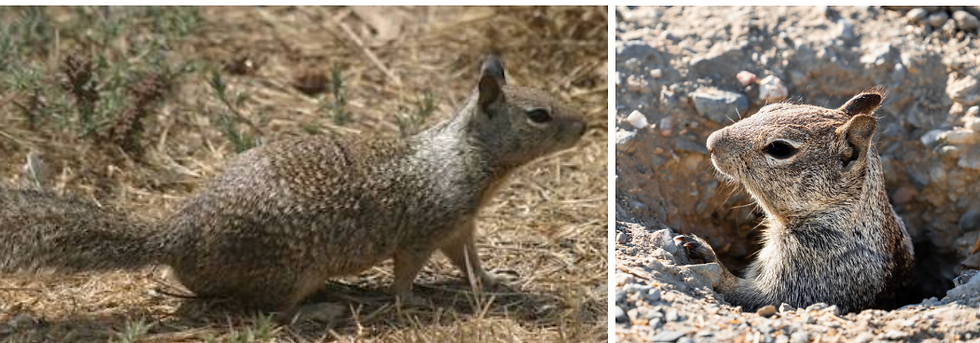
Photo Credits: Nature Mapping, San Diego Zoo Wildlife Alliance
Despite the resilience of these ecosystems, Oak Woodlands face several serious threats. With climate change increasing extreme temperatures and long dry seasons, wildfires pose a significant danger to even fire-adapted species. Furthermore, prolonged heatwaves and drought stress weaken trees, reduce acorn production, and negatively impact the entire ecosystem. Sudden Oak Death is a tree disease caused by a fungus-like plant pathogen (Phytophthora ramorum) that causes dark, irregular-shaped cankers on the trunk or branches that produce ooze (Sudden Oak Death, 2020). It can cause leaves to turn brown and new growth to wilt or die back. While Blue Oak is resistant to sudden oak death, this disease has devastated Coast Live Oak populations throughout coastal California. Additionally, urban and agricultural development continues to fragment Oak Woodlands habitats, cutting off wildlife corridors and isolating species populations.
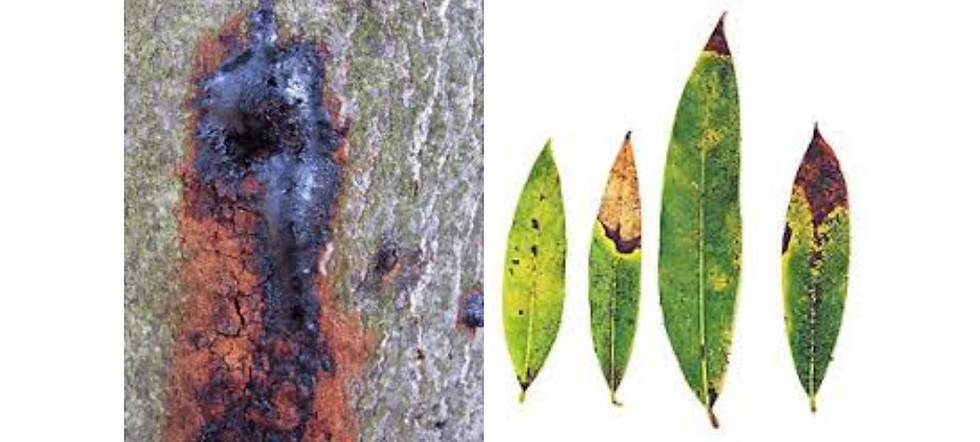
Photo Credit: Center for Invasive Species Research, Woodlands.co.uk
Oak Woodlands are one of the most productive ecosystems in the state and provide essential ecosystem services. They provide flood control by absorbing rainfall in the soil, carbon sequestration, which pulls carbon dioxide out of the atmosphere, and a habitat for over 300 vertebrate species (Oak Woodland Wildlife | UC Oaks, 2026).
You can experience Oak Woodlands firsthand right here in Orange County on OC Habitats hikes, where you can walk beneath the Coast Live Oaks and spot some of the many species that call this ecosystem home. OC Habitats works to protect and restore Oak Woodlands and many other ecosystems in Orange County through restorations, our hike programs, and community education events throughout the year. Please come visit us to learn more about this beautiful habitat!
Works Cited
California Oak Tree Species ID and Ecology | UC Oaks. (2026, March 23). UC Agriculture and Natural Resources. https://ucanr.edu/site/uc-oaks/california-oak-tree-species-id-and-ecology
Pacific Horticulture | The Most Majestic Southern California Oak. (2024, May 10). Pacific Horticulture. (2024, May 10). The most majestic Southern California oak. Pacific Horticulture.
Sudden Oak Death. (2020). Suddenoakdeath.org. https://www.suddenoakdeath.org/
How to Identify An Engelmann Oak. (2026). Arroyoseco.org. https://www.arroyoseco.org/identifyengelmann.htm
NatureServe Explorer 2.0. (2025). Natureserve.org. https://explorer.natureserve.org/Taxon/ELEMENT_GLOBAL.2.722743/Southern_California_Oak_Woodland_and_Savanna
Coast Live Oak. (2018, September 4). Golden Gate National Parks Conservancy. https://www.parksconservancy.org/conservation/coast-live-oak
Oaks. U., Beckman, E., Gaman, T., Meyer, A., & Westwood, M. (n.d.). Conservation Gap Analysis of Native Species profile: Quercus engelmannii SPECIES OF CONSERVATION CONCERN CALIFORNIA. Retrieved May 28, 2026, from https://mortonarb.org/app/uploads/2021/08/species-profile-quercus-engelmannii.pdf
Oak Woodland Wildlife | UC Oaks. (2026, April 2). UC Agriculture and Natural Resources. https://ucanr.edu/site/uc-oaks/oak-woodland-wildlife
Holland, V. (n.d.). California Wildlife Habitat Relationships System California Department of Fish and Game California Interagency Wildlife Task Group Coastal Oak Woodland. https://nrm.dfg.ca.gov/FileHandler.ashx?DocumentID=67344&inline
Ritter, L. (n.d.). California Wildlife Habitat Relationships System California Department of Fish and Game California Interagency Wildlife Task Group Blue Oak Woodland. https://nrm.dfg.ca.gov/FileHandler.ashx?DocumentID=67340&inline


Comments