


Climate Change in the Rocky Intertidal Zone
By: Abby Harsche
2025
Climate change per the Oxford Dictionary is “a change in global or regional climate patterns, in particular a change apparent from the mid to late 20th century onwards and attributed largely to the increased levels of atmospheric carbon dioxide produced by the use of fossil fuels.” This phenomenon affects the environment in many different ways. It causes higher variability in weather events, rising temperatures, sea level rise, drought, flooding, and so much more. These events affect things that we depend upon and value like water, energy, transportation, wildlife, agriculture, ecosystems, and human health. According to NOAA, the rate of warming since 1982 is more than three times as fast: 0.36° F (0.20° C) per decade (climate.gov 2025). Additionally, 2024 was the warmest year since global records began in 1850 by a wide margin (climate.gov 2025).

While climate change affects all aspects of our environment, the rocky intertidal zone faces its own threats from the rising temperatures. Climate change disrupts intertidal food chains by altering ocean temperature which negatively impacts the primary producers (e.g., plant, algae) and thus causes supply issues from the bottom up. To evaluate closer, let’s look at some common California coast species.
Purple sea urchins (Strongylocentrotus purpuratus):

In 2014, the sunflower sea star (Pycnopodia helianthoides) faced massive die off due to sea star wasting disease (Western Fisheries Research Center 2025). Recent discoveries have proven that a strain of the bacterium Vibrio pectenicida is the cause of the disease, exacerbated by marine heatwaves (Western Fisheries Research Center 2025). The die-off of the sunflower sea stars, the primary predator of purple sea urchins, has led to unchecked population growth. The increase in purple sea urchins has led to the widespread destruction of kelp forests because sea urchins eat the kelp and can decimate an ecosystem if unchecked. However, kelp forests are crucial habitats and food sources for many marine species such as snails and abalone as well as fish such as Garibaldi and Rockfish. Scientists have been attempting to manually remove urchins in certain areas, but this is a labor-intensive, costly, and limited solution that cannot be sustained on a large enough scale to resolve the issue statewide.
Mussels (Mytilidae):

Increasing water temperatures stress their physiology by shifting their energy balance and allocations and can lead to mass mortality events (Responsible Seafood Advocate 2024). Moreover, rising temperatures have been shown to lead to more porous and weaker shells, making them more susceptible to damage from predators and environmental factors (Responsible Seafood Advocate 2024). According to Leanne Melbourne, the mussel study’s lead author and a postdoctoral fellow at the museum, “Mussels are important on so many levels: they provide habitats on reefs, they filter water, they protect coasts during storms and they are important commercially as well.” (Responsible Seafood Advocate 2024).
Ochre sea star (Pisaster ochraceus):
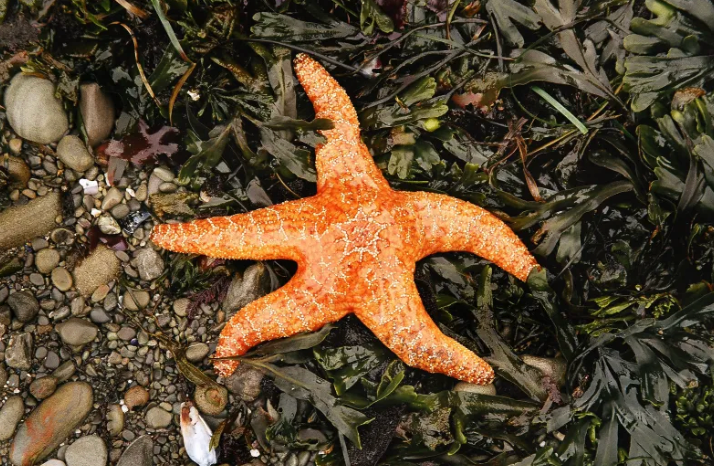
Sea star populations (Pisaster) in the U.S. West Coast saw a huge decline from 2014 to 2016 due to sea star wasting syndrome, which coincided with the “warm blob” and a strong El Niño year that heated up ocean waters. As a keystone species–defined by the Oxford Languages as “a species on which other species in an ecosystem largely depend, such that if it were removed the ecosystem would change drastically” – the ochre sea star plays a vital role in maintaining the health of intertidal communities by preying on mussels and sea urchins. Population declines caused by the wasting disease can lead to an increase in both species populations, which can outcompete other species for space and reduce biodiversity.
As ocean temperatures have continued to rise, sea star wasting disease has continued to be a concern for scientists. While some sea star populations have shown signs of recovery, the disease is still present and continues to impact the health and numbers of many species, such as the critically endangered sunflower sea star.
Surf grass(Phyllospadix):

Surf grass, like other seagrasses, relies on sunlight for photosynthesis and thrives in shallow coastal waters. As sea levels rise, the increased water depth can decrease the amount of light reaching surf grass beds, reducing growth rates. This effect is worsened by increased water turbidity from storms and runoff. Surf grass meadows are vital habitats that provide shelter and nursery grounds for many species, including juvenile fish, invertebrates, and commercially important species like spiny lobsters (Palinuridae). The loss of these habitats can have cascading effects on the wider marine food web. Surf grass roots and leaves stabilize seafloor sediments and dissipate wave energy, protecting coastlines. Without healthy surf grass beds, coastal communities become more vulnerable to erosion and flooding from storms.
Climate change affects entire ecosystems broadly and more specifically. Because of rising temperatures and all of its implications, you can see changes in species populations and biodiversity. When you look closer you see that individual food chains and webs are also impacted. When one species is depleted, its prey populations grow larger and its predator populations also decrease because they have no food, a vicious and dangerous cycle.
Climate change is a persistent problem that cannot be solved at the individual level. However, if you are looking to become more eco-friendly and lessen your contribution to anthropogenic climate change there are many things you can do day-to-day. One way to lessen your carbon footprint is reducing your overall consumption, buying second hand, and avoiding excessive consumerism. Buying second hand allows clothing and other items to have a second life. Not only does this reduce the need for companies to produce more products, but it extends the life and promotes recycling of materials. You can also participate in habitat clean-ups to remove trash and other debris from ecosystems before it enters streams, rivers, wetlands, and the ocean and breaks down. Removing debris from habitats allows the ecosystems to remain healthy for all of its function and inhabitants. Moreover, cleanups reduce the pollution within the soil and any sort of microplastics or debris that may be breaking down. Lastly, you can educate yourself and continue to educate those around you about the effects of climate change and measures that you can take to lessen it. While these actions may seem small on their own, together they play an important role in supporting environmental sustainability.
Works Cited
Climate.gov. (2025). Climate change: Global temperature. NOAA. Retrieved December 5, 2025,
from https://www.climate.gov/news-features/understanding-climate/climate-change-global-temperature Climate.gov
Responsible Seafood Advocate. (n.d.). Have mussel shells become more porous due to climate
Western Fisheries Research Center. (2025, August 4). Solving the mystery of sea star wasting
disease: A breakthrough discovery. U.S. Geological Survey. Retrieved December 5,


Comments